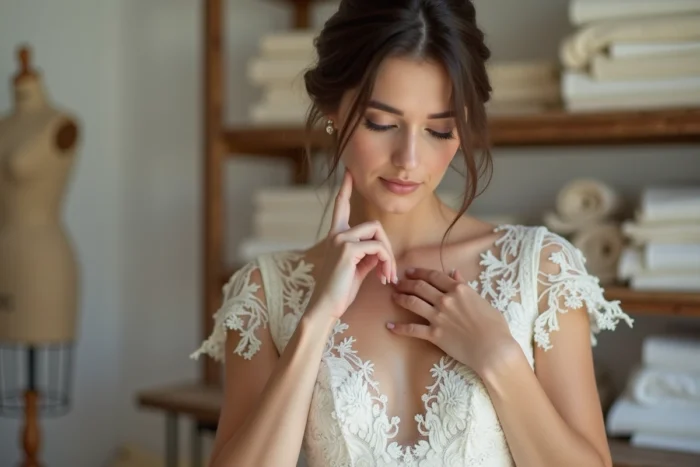
Chantilly lace is a fabric made of fine tulle, adorned with floral patterns outlined by a thicker thread (the “cordonnet”) that highlights each detail in a light relief. Originally made from black silk in the Chantilly region, it is distinguished by its transparency and flexibility, two properties that explain its recurring presence in the making of wedding dresses.
Cordonnet and tulle density: what determines the hold of a Chantilly on a dress
The cordonnet is the thicker thread that borders each motif of the lace. Its thickness directly influences how it falls on the body. A fine cordonnet produces an airy effect, almost blending into the tulle, suitable for veils and light overlays.
A more pronounced cordonnet structures the fabric more and is suitable for bodices or long sleeves where the lace must stand alone, without an opaque lining. During a fitting, running a finger along the edge of a motif allows you to feel this difference.
The density of the base tulle plays a complementary role. Very fine tulle allows the skin to show through clearly, which is suitable for an illusion neckline or a bare back. Slightly denser tulle softens the transparency without adding weight, an option often chosen for sleeve dresses intended for religious ceremonies.
Finding the ideal Chantilly lace for a wedding largely depends on this balance between cordonnet and tulle density, which dictates both the visual effect and comfort.
Chantilly lace in silk, organic cotton, or recycled polyamide: composition and practical consequences
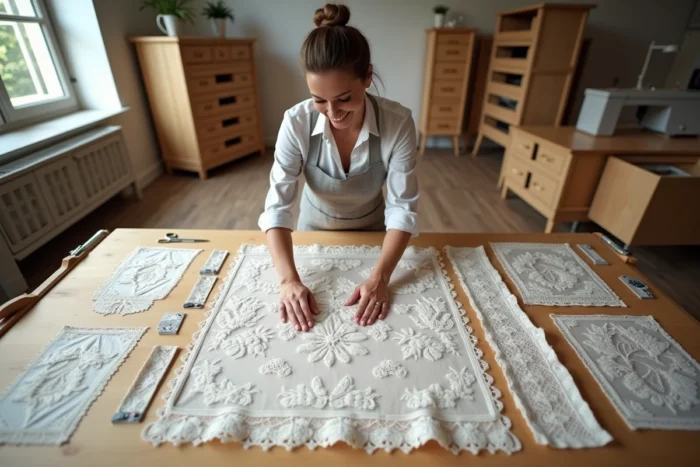
The composition of the thread significantly changes the behavior of the fabric. Silk Chantilly offers a natural sheen and a very soft touch, but remains sensitive to moisture and friction. It requires dry cleaning after the ceremony and storage away from light to prevent yellowing.
In recent years, French lace houses like Sophie Hallette and Maison Jean Bracq have offered Chantilly incorporating certified organic cotton or recycled polyamide, without visible alteration of the fineness of the patterns. These references were showcased at the Interfilière Paris 2024 trade fair in the “lace & embroidery” category dedicated to bridal.
Criteria for comparing compositions
- Natural silk: warm sheen, fluid drape, delicate care, highest price per meter among the fibers used in Chantilly.
- Organic cotton: slightly more pronounced matte appearance, good resistance to gentle washing, suitable for brides who want documented environmental traceability.
- Recycled polyamide: superior mechanical resistance, quick drying, relevant for dresses worn outdoors or in humid climates. The touch remains close to classic polyamide.
The future European Regulation on the eco-design of sustainable products (ESPR), adopted by the European Parliament on April 23, 2024, provides for a digital product passport for textiles. Ultimately, the precise composition and country of manufacture of each lace must be documented, facilitating the verification of this information with the designer or sewing workshop.
Floral, geometric, or mixed patterns: choosing according to the silhouette of the dress
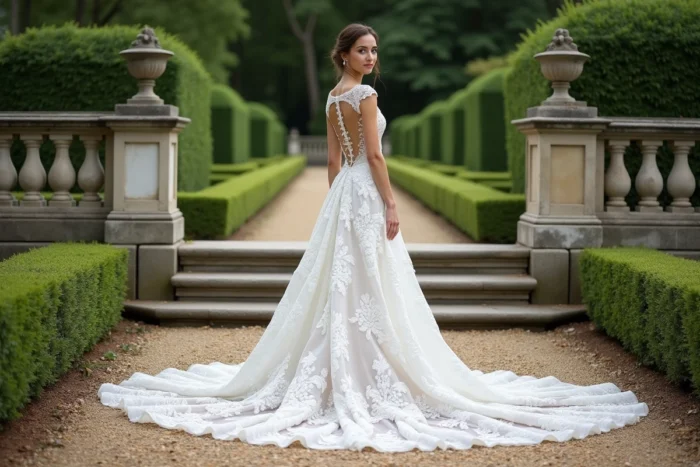
The patterns of a Chantilly are not interchangeable. A large floral pattern, with roses or peonies spanning several centimeters, draws the eye and creates a focal point. Placing a large pattern on a fitted bodice adds visual volume to the bust, while the same pattern on a flared skirt blends into the movement of the fabric.
Smaller or geometric patterns (elongated diamonds, repetitive curved lines) produce a uniform texture effect. They work well on sheath dresses or mermaid silhouettes, where the lace hugs the body without creating a visual break.
Matching the lace design to the style of the ceremony
A bohemian dress with flared sleeves supports airy patterns, with areas of bare tulle between the flowers. A structured classic-style dress benefits from using a Chantilly with tight patterns, which almost mimics a solid fabric while retaining the lightness characteristic of lace.
The placement of the patterns on the pattern determines as much the final result as the choice of the lace itself. A custom creation workshop cuts each panel taking into account the symmetry of the patterns at the seams, a task that industrial manufacturing does not always guarantee.
Chantilly lace and Calais lace: a frequent confusion to clarify
Calais-Caudry lace is a designation that refers to a place of manufacture and a Leavers loom technique, not a style of pattern. A Chantilly can be produced in Calais-Caudry on a Leavers loom, but it can also be made elsewhere, on other types of looms.
Not all Calais lace is Chantilly, and not all Chantilly is made in Calais. Calais guipure, for example, is a fabric without a tulle base, with motifs connected by brides, visually very different from Chantilly.
During a fitting, asking the designer to specify both the type of lace (Chantilly, guipure, embroidered tulle) and its place of manufacture helps avoid confusion. A label stating “Calais lace” without specifying the style provides only partial information about the final look of the dress.
The choice of a Chantilly for a wedding dress is based on measurable technical criteria: thickness of the cordonnet, density of the tulle, composition of the thread, size and placement of the motifs. Each of these parameters modifies the drape, transparency, and care of the garment. Checking them one by one during the fitting remains the most reliable method to achieve the desired result.