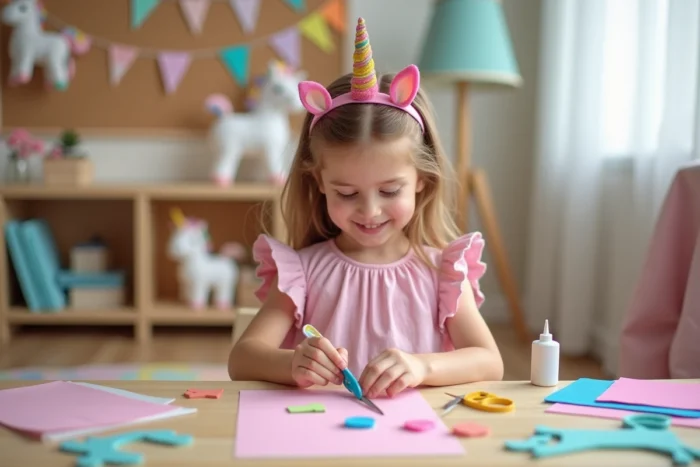
The unicorn holds a unique place in children’s imagination. Beyond being just a cartoon character, it now serves as a support for documented educational and therapeutic practices. The professional journal Enfance & Psy, in its issue 90 dedicated to imagination and care, mentions the use of unicorn characters in therapeutic mediation by French-speaking speech therapists and psychomotor therapists. This shift from toy to educational tool changes the way we can approach creative activities for children passionate about unicorns.
Unicorn and Emotion Management: A Use That Goes Beyond Creative Leisure
The enchanting world of the unicorn functions as a transitional space for young children. Health professionals rely on role-playing games and “unicorn emotion cards” to work on self-confidence and cooperation. The child projects their own feelings onto a benevolent character, which facilitates verbalization.
This detour through fiction is not anecdotal. In psychomotor sessions, naming a unicorn, attributing an emotion to it, and then drawing or modeling it allows the child to distance themselves from sometimes difficult experiences. The creative dimension (coloring, modeling, making accessories) reinforces the sensory grounding of the exercise.
This logic can be found in the children’s activities on Licorne Cosmique, where the proposals combine manipulation, storytelling, and a rainbow universe without limiting themselves to simple decoration.

Unicorn Box and Creative Kit: What Distinguishes a Good Product
The market for unicorn kits for children is saturated. Between jewelry kits, diamond painting sets, and customizable plush toys, the choice can seem overwhelming. Not all these products are equal, and a few concrete criteria can help sort them out.
- The actual activity duration: a kit that occupies a child for less than twenty minutes ends up at the back of a cupboard. Unicorn diamond painting kits or jewelry assembly kits (like Djeco) generally offer a longer engagement time than simple pre-cut coloring pages.
- The quality of materials: the beads, threads, and supports must withstand repeated handling. A kit whose pieces break on first use generates frustration, not creativity.
- The child’s autonomy: the best kits provide clear visual instructions, suitable for children from six years old, without requiring constant adult intervention.
- The possibility of extending play: a kit that produces a finished object (bracelet, room decoration, character) is more valuable than a disposable consumable. The child keeps a tangible result of their work.
Djeco kits regularly appear in recommendations, particularly for their refined aesthetics and the sturdiness of their components. In contrast, feedback on some kits sold in supermarkets varies, where low prices sometimes result in fragile accessories.
Diamond Painting and Airbrush: Two Opposing Approaches
Unicorn diamond painting appeals with its meditative aspect. The child places small colored rhinestones on an adhesive support following a numbered pattern. The result, often intended to decorate a room, values patience and precision.
In contrast, customizable unicorn plush toys with electric airbrush offer a more spontaneous and sensory experience. The child sprays color directly onto the plush toy, satisfying a need for broad gestures and experimentation. Both formats cater to different temperaments and can coexist within the same sibling group.
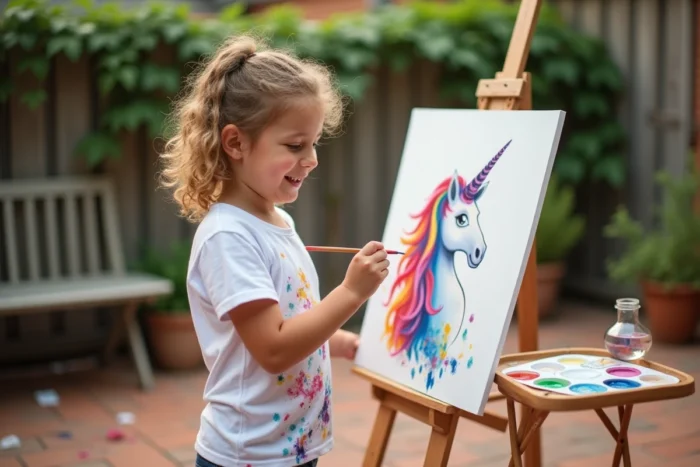
Digital Unicorn Workshops: Programming and Games for Six to Ten-Year-Olds
A recent development deserves attention: programming workshops use the unicorn as a hero in video games to introduce children to coding. The child programs the movements of a unicorn in a magical universe, learning loops and conditions through a visual block language.
This approach works because it captures a pre-existing interest. A child passionate about unicorns more easily accepts the frustration associated with learning to code when the visual result corresponds to their favorite universe. Feedback varies on the optimal age to start: some workshops welcome children from six years old, while others believe that the necessary sequential logic only solidly establishes around eight years old.
Inclusive Unicorn Kits: Diversity of Bodies and Representations
In recent years, creative leisure publishers have offered unicorn activities where the child can choose the skin color of their character, add mobility aids, or sensory accessories. This inclusive approach normalizes diversity and disability through play.
The movement, which originated with Anglo-Saxon publishers like Learning Resources (the “Inclusive Play” section of their catalog), is gradually gaining traction in the French-speaking market through online platforms. The “Diversity & Inclusion” selection on Etsy France lists several creators who explore this idea.
The educational interest goes beyond simple representation. When a child creates a unicorn in a wheelchair or wearing glasses, they naturally integrate that magic and difference are not mutually exclusive. Role-playing around these figurines opens conversations that adults might find difficult to initiate directly.
Choosing an Age-Appropriate Unicorn Activity
The classic trap is to offer a kit that is too complex for a four-year-old or, conversely, a coloring activity that is too simple for a nine-year-old. The unicorn theme covers a wide age range, but the medium must correspond to the stage of motor and cognitive development.
- Before five years: unicorn modeling clay, repositionable stickers, ink stamps. The gesture is broad, and the result is immediate.
- Between five and eight years: jewelry kits, bead kits, simplified diamond painting. Fine motor skills develop, and the child enjoys following steps.
- Beyond eight years: sewing workshops for plush toys, visual programming, creating themed notebooks or journals. The child seeks a project they can carry from start to finish.
A child who prefers stories to manipulation will find more satisfaction in a narrative role-playing game around the unicorn than in a bead kit. The theme remains the same, but the channel of expression changes. Adapting the format to temperament is as important as respecting the age range indicated on the box.