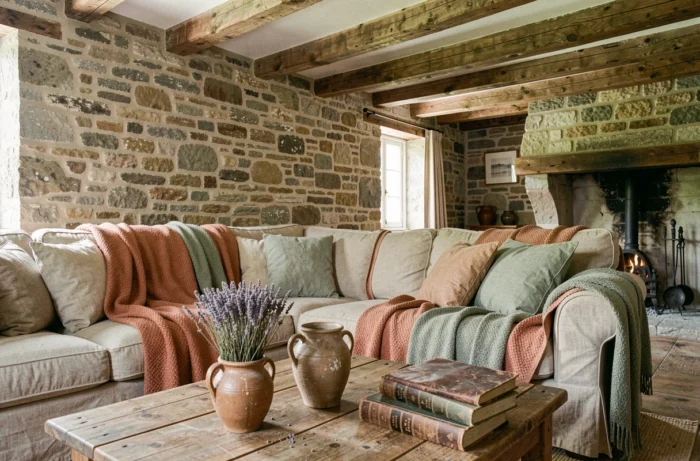
The charm of a house is not decreed by the accumulation of decorative objects. It rests on a dialogue between the original materials, the chosen furniture, and the way light flows through each room. To arrange with authenticity means first identifying what already exists in a place (stone, wood, volume, orientation) before adding anything.
Reuse of old materials: traceability and compatibility before aesthetics
Recovering an old floor, cement tiles, or farmhouse doors to integrate into a contemporary interior goes beyond mere decorative trend. Professionals now recommend documenting the origin and structural condition of each recovered element before any installation. An old oak floor may seem perfect on the surface but may have invisible structural weaknesses (boards weakened by moisture, corroded nails, insufficient thickness for sanding).
Regulatory compatibility also comes into play. A masonry element recovered from a demolition may not be suitable for load-bearing use in another construction. Checking the previous usage conditions avoids costly disappointments.
For those looking to combine vintage pieces and new furniture in a coherent manner, it is possible to discover the home page of La Maison De Daniel to explore ranges that harmonize with characterful interiors.
- Check the strength of the joints (tenons, mortises, dowels) rather than relying on the patinated appearance of the wood
- Photograph and record the provenance of each recovered piece to ensure its traceability
- Verify compatibility with current standards, especially for electrical elements or floor coverings
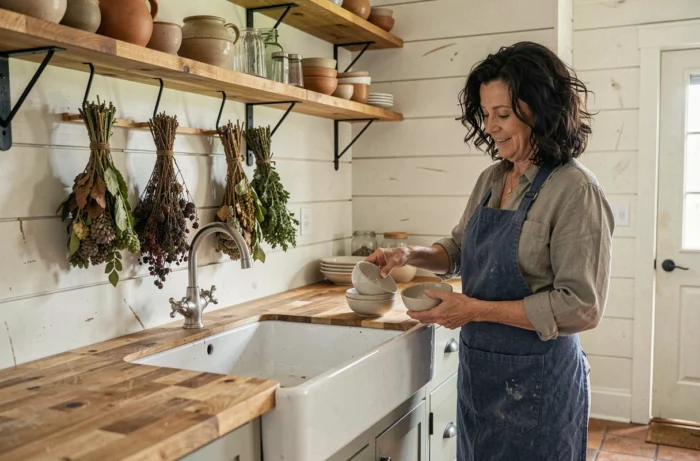
Raw materials and repairable furniture: the criteria for a sustainable interior
Solid wood, natural stone, linen, terracotta: these materials age without going out of style. Their common point is a capacity to develop a patina rather than degrade. A waxed oak piece improves with time, while a melamine panel eventually swells at the slightest contact with water.
The durability of a piece of furniture is not just about its appearance. Repairability matters as much as the material. Key criteria include the availability of spare parts, the disassemblability of elements, and the use of mechanical joints (screws, dowels) rather than permanent adhesives. An armchair whose strap can be replaced or seat can be retensioned has a much longer lifespan than a monobloc model.
Wood, linen, and terracotta: combining textures without overloading
An old terracotta floor, a raw walnut table, and washed linen curtains are enough to create a warm atmosphere without unnecessary additions. Charm arises from the coherence of textures, not from their accumulation. Three well-matched natural materials create more visual depth than ten decorative accessories.
A common pitfall is to multiply wood species in the same room. Two species with similar tones work well together (oak and beech, for example). Beyond that, the “catalog” effect takes over, and the eye doesn’t know where to settle.
Energy renovation and architectural charm: a technical arbitration
Arranging an old house authentically often requires renovation. Large-scale renovation projects must now aim for a gain of at least two energy classes and integrate several insulation measures, according to the requirements of the Ministry of Ecological Transition.
This constraint sometimes conflicts with the preservation of a building’s character. Insulating the interior of exposed stone walls means masking precisely what gives the place its charm. Insulating from the outside alters the facade. There is no universal solution, but some concrete arbitrations.
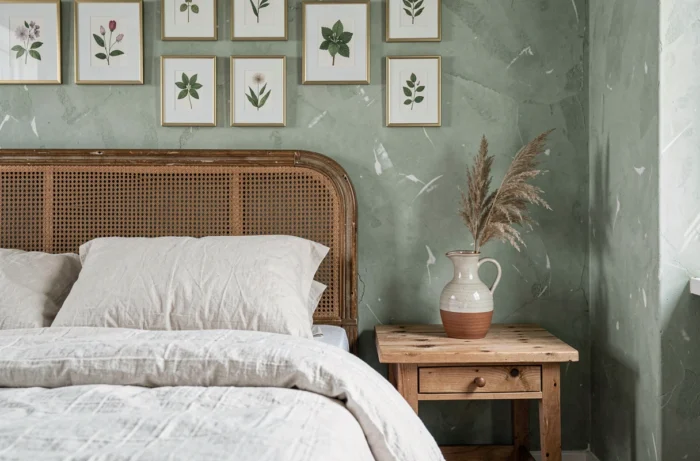
Preserving stone walls while effectively insulating
Interior insulation with a lime-hemp plaster represents an interesting compromise for stone walls. This type of plaster naturally regulates humidity, allows the masonry to breathe, and offers a raw finish compatible with a rustic style.
For ambitious projects, consulting a “Mon Accompagnateur Rénov'” has become a structuring step. This professional helps establish the work program, compare quotes, and secure financing, which avoids sacrificing heritage elements due to a lack of knowledge about technical alternatives.
Furniture and decoration: choose according to the spirit of the place rather than the trend
A charming house derives its personality from its architectural particularities: ceiling height, period fireplace, spiral staircase, alcoves. The furniture should fade in front of these elements, not compete with them.
In practical terms, this means favoring simple lines for furniture when the architecture is rich. A sculpted stone fireplace does not need a baroque mirror above it: a simple frame or a bare wall highlights it more.
- In a room with exposed beams, opt for low furniture that allows the eye to rise to the ceiling
- Against a stone wall, choose solid-colored textiles rather than busy patterns that create visual competition
- For a room with old tiles on the floor, limit rugs to comfort zones (foot of the bed, in front of the sofa) without masking the original covering
The elegance of an authentic interior often lies in what has been chosen not to add. A clear space around a remarkable element is enough to give it all its presence. The most useful final touch in arranging may sometimes be to remove an object rather than add a new one.