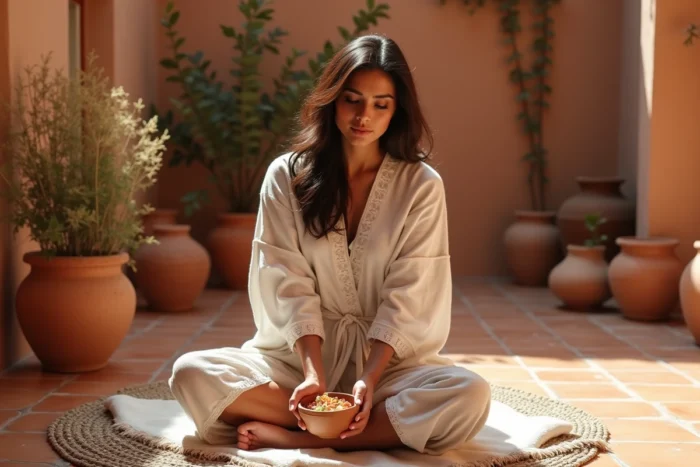
Ancestral beauty rituals are making a strong comeback in contemporary routines, driven by millions of views on social media and the launch of cosmetic lines that claim a mythological heritage. Behind this trend, ingredients used since antiquity (olive oil, clay, plant powders) are experiencing a resurgence of commercial interest, but also an increasingly strict European regulatory framework. The gap between marketing promises and documented reality deserves careful examination.
Ancestral Ingredients and European Cosmetic Regulation
The legal framework is a key angle for understanding the marketing of these products. In Europe, the Regulation (EC) No 1223/2009 governs the marketing of any cosmetic product, including those claiming traditional formulations. The CosIng database, regularly updated by the European Commission, lists the permitted ingredients and their usage restrictions.
The CSSC (Scientific Committee on Consumer Safety) has published recent opinions on several plant extracts and essential oils often associated with ancient rituals. These opinions highlight risks of skin sensitization or phototoxicity for certain concentrations. Specifically, undiluted bergamot essential oil or cinnamon extract used “as in the past” could today pose compliance issues.
To delve into the historical and cultural dimension of these practices, one can explore beauty secrets on Blog Beauté that trace the origins of several iconic rituals.
The trend of labeling a product as “ancestral” or “inspired by goddesses” does not exempt manufacturers from providing a complete safety dossier (DIP) proving the safety of each formula. The available data does not allow for a conclusion that all products marketed under this banner comply with this framework, but monitoring has significantly increased since 2023.
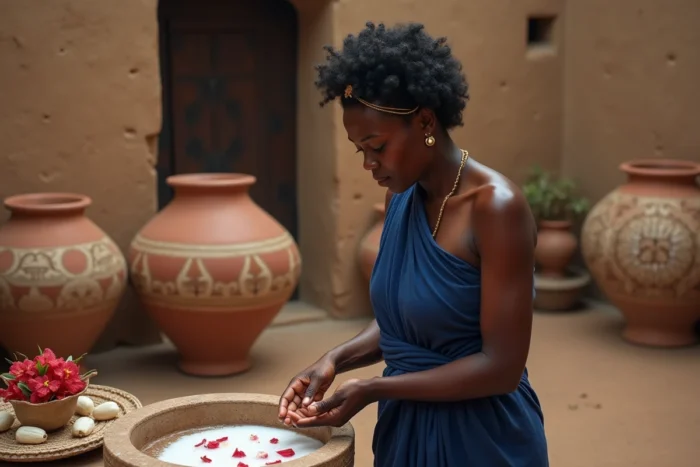
Beauty Rituals on TikTok: Trend or Lasting Rediscovery
Since 2022, hashtags related to ancestral beauty rituals (#ancientbeauty, #cleopatraskin, #ayurvedicskincare) have accumulated several hundred million views on TikTok. This visibility has led to a noticeable increase in Google searches and sales for products like castor oil, black seed oil, or Ayurvedic powders.
The correlation between spikes in video content and the launch of new marketing lines is documented. However, field feedback varies on the sustainability of this enthusiasm. Some brands have observed a rapid decline in sales after the visibility of a viral content decreased, suggesting a fleeting trend rather than a fundamental change in skincare habits.
What Viral Videos Don’t Show
Content creators often present an ancestral beauty ritual in a few seconds, without mentioning necessary precautions. The direct application of turmeric to the face, popular in some videos, can cause irritation on sensitive skin. Similarly, using untested raw clay offers no guarantee of purity.
The short format of social media encourages simplification. An ancient Egyptian or Greek ritual was embedded in a specific cultural, dietary, and climatic context. Reproducing an isolated gesture without its original context does not carry the same significance as the complete practice from which it originates.
Vegetable Oils and Clays: What Science Confirms (and What It Nuances)
Among the ingredients most associated with ancestral rituals, some have a solid scientific foundation, while others much less so.
- Olive oil, used in ancient Greece, contains squalene and polyphenols whose antioxidant properties have been documented in several dermatological studies. Its oleic acid profile makes it suitable for dry skin, but potentially comedogenic on combination to oily skin.
- Clay (green, white, volcanic) has recognized adsorbent properties, useful for absorbing excess sebum. Quality varies greatly depending on the source and treatment: cosmetic clay tested has nothing to do with raw clay harvested in the wild.
- Ayurvedic powders (amla, brahmi, neem) are increasingly studied for their antimicrobial and anti-inflammatory properties, but effective concentrations and interactions with other actives remain poorly documented for standardized topical use.
The common point of these ingredients: their effectiveness depends heavily on formulation, concentration, and skin type. Ancestral rituals functioned within a global ecosystem (diet, climate, lifestyle) that cannot be reduced to the application of a single product.
Marketing Claims and Mythology: The Blurred Line
The use of the goddess figure (Aphrodite, Cleopatra, Lakshmi) in cosmetic marketing serves a specific purpose: to associate a product with a promise of transcendent beauty. This strategy is not new, but it has accelerated with the virality of social media.
The problem lies in the gap between the claim and the proof. Stating that a cream “is inspired by Cleopatra’s donkey milk ritual” does not constitute proof of effectiveness. Cosmetic claims in Europe must be truthful, verifiable, and substantiated according to the regulation on cosmetic claims.
What Differentiates Documented Tradition from Storytelling
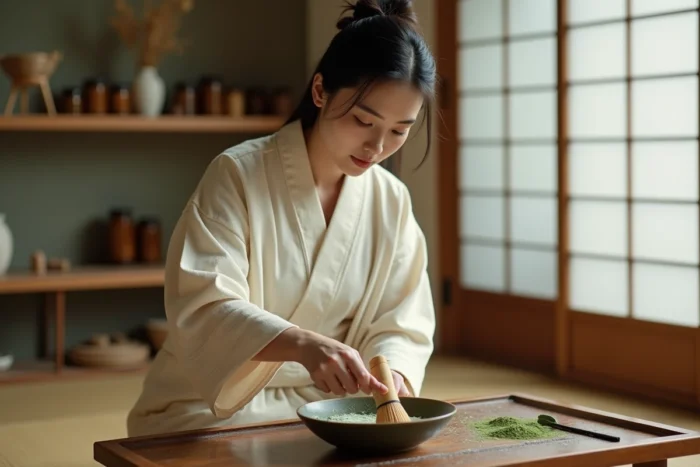
Some ancestral practices are based on verifiable historical sources. Egyptian medical papyri describe preparations made from oils and resins. Ayurvedic texts codify detailed care protocols. These sources allow for distinguishing a documented heritage from a purely commercial narrative construction.
In contrast, the majority of “goddess-inspired” products do not cite any specific sources. They rely on a collective imagination, which is not prohibited, but does not fall under tradition in the strict sense.
Ancestral beauty rituals contain real empirical knowledge, sometimes validated by contemporary research. Their commercial appropriation remains subject to a regulatory framework that consumers would benefit from understanding before choosing a serum labeled “ancestral ritual.”