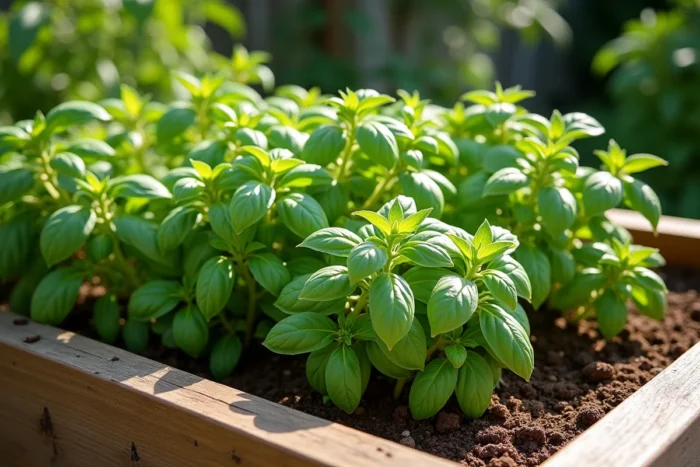
Basil grows quickly, smells good, and enhances almost all summer dishes. However, sometimes a bad neighbor in the vegetable garden is enough for its leaves to turn yellow, its growth to slow down, or pests to settle in. Some plants, even popular ones in the garden, create conditions around basil that are frankly unfavorable to it.
Basil and air circulation: the trap of overly dense plants
Have you ever noticed brown spots on your basil leaves at the end of summer? These are often the first signs of downy mildew or fusarium wilt, two diseases caused by microscopic fungi.
Basil is particularly vulnerable when air does not circulate well around its foliage. According to a technical sheet from the Centre de référence en agriculture et agroalimentaire du Québec (CRAAQ), basil becomes much more sensitive to downy mildew in confined environments, with little ventilation. The shade cast and the density of tall or very bushy plants clearly increase this risk.
Specifically, plants that form woody and compact bushes (like a large untrimmed sage or rosemary plant) block natural ventilation. Even very bushy marigolds can pose a problem if they closely surround the basil.
The solution is simple: always leave a clear space around your basil plants. A row of low lettuce or bare mulch is better than a neighbor that acts as a screen. You will also find Jardinier.net’s gardening tips useful for organizing your rows without suffocating your herbs.
Mint, sage, and thyme: three herbs to keep away from basil
Herbs are often planted together for convenience. All in the same place, all in the same planter. This is precisely where the troubles begin.
Mint and basil: a duo that attracts pests
Basil naturally repels thrips and certain flies. Mint, on the other hand, sometimes attracts and harbors aphids and whiteflies. As a result: mint can create a reservoir of pests right next to basil, according to companion planting tests reported by the site Un Point Culture.
In addition to this health problem, mint is an invader. Its runners colonize the soil in a few weeks and deprive basil of water and nutrients. In open ground, never place them side by side without a physical barrier (like a buried pot, for example).
Sage and thyme: opposite water needs
Sage and thyme are Mediterranean plants adapted to dry and poor soils. They hate stagnant moisture. Basil, on the contrary, needs cool soil and regular watering.
Associating basil with thyme or sage forces you to choose a watering regime that only suits one of the two groups. Either basil lacks water and wilts, or the Mediterranean herbs rot from excess moisture. This is not a problem of mysterious compatibility; it’s a matter of soil and water.
Basil and root competition in pots: the container factor
The problem worsens when growing in pots or planters, which is the case for many urban gardeners. In a small volume container, competition for water and nutrients becomes fierce.
Pot trials show that <strong, in small diameter containers, basil loses growth and essential oil concentration if it shares space with other greedy herbs. Tarragon, for example, develops a dense root system that quickly monopolizes the available substrate.
For pot cultivation, here are the plants to avoid in the same container as basil:
- Mint, whose runners invade the entire volume in a few weeks and can harbor aphids.
- Tarragon, whose deep roots absorb water before basil can benefit from it.
- Sage and thyme, which require a more draining substrate and less watering than basil.
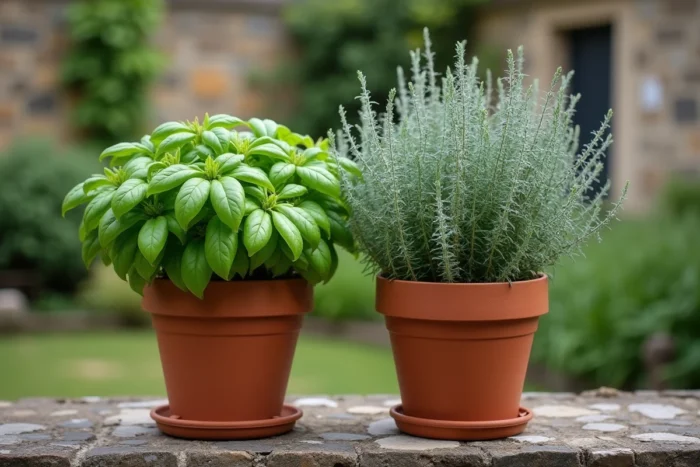
If you only have one planter, reserve an individual pot for basil and group the Mediterranean herbs (thyme, rosemary, sage) in another container with a more mineral substrate.
Fennel and rue in the vegetable garden: two toxic neighbors for basil
Fennel is a special case in the vegetable garden. It secretes substances through its roots that inhibit the growth of many neighboring plants. Basil is not exempt from this allelopathy. In practice, a fennel plant planted less than a meter from basil is enough to visibly slow its growth.
Rue officinalis poses a similar problem. This perennial herb is known to be incompatible with most plants in the Lamiaceae family, of which basil is a part. Fennel and rue must be isolated in a dedicated corner of the vegetable garden, away from sensitive herbs and vegetables.
Associations to favor to protect basil
Rather than listing what works poorly, here are the neighbors that benefit basil:
- Tomato: basil repels certain tomato pests, and the tomato provides slight shade without blocking air circulation.
- Bell pepper and chili, which share the same water and heat needs.
- Leafy lettuce and low salads, which cover the soil without creating significant root competition.
- Cilantro, provided it is planted at a reasonable distance to avoid excessive density.
These associations work because they respect basil’s two main requirements: a cool, well-watered soil, and good air circulation around the foliage.
Choosing the right neighbors in the vegetable garden is not a theoretical exercise. A poorly surrounded basil produces fewer leaves, loses flavor, and gets sick faster. By giving it an airy space, appropriate watering, and compatible companions, you will achieve significantly more generous harvests throughout the summer.