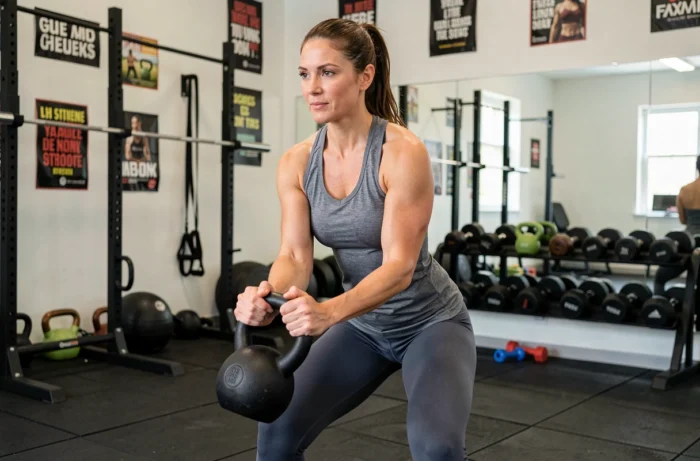
Having a workout sheet in front of you during training changes the game. No screen to unlock between sets, no video that pauses at the wrong moment. A kettlebell session printed on paper allows you to stay focused on the movement, breathing, and rest timer.
Grip and order of exercises: what your sheet should include
Have you ever felt your fingers give out before your legs got tired? This is the most common problem with kettlebells. The grip fatigues faster than the major muscle groups, especially during ballistic movements like the swing or the clean.
A well-constructed sheet places the most demanding grip exercises at the beginning of the session, when the forearms are fresh. If you schedule swings after ten minutes of farmer walks, your grip won’t hold up. The result: deteriorating technique and a risk of dropping the kettlebell.
To organize your training, you can download a complete kettlebell session to print that follows this sequencing logic.
Place technical and ballistic movements first, then follow up with ground exercises or grinds (slow and controlled movements). Finish with core work or a light finisher that doesn’t stress the grip.
Kettlebell and progression over several weeks: beyond a single session

Most PDF sheets offer a single fixed session. You repeat it, get used to it, and results stagnate. A truly useful sheet incorporates a progression plan, even a simple one.
The principle consists of two steps. First, increase the repetitions. If your sheet specifies three sets of eight goblet squats, move to three sets of ten when the movement is mastered. Then, increase the load only when all sets are performed with proper technique.
This rule avoids a common pitfall: increasing weight too quickly because you feel “comfortable.” The kettlebell is less forgiving than traditional dumbbells. A poorly controlled swing with a load that’s too heavy can strain the lower back brutally.
Annotating your sheet to track progress
Print several copies of the same sheet. Each week, write down the actual number of repetitions performed and the load used. This paper tracking replaces a workout journal and clearly shows progress from week to week.
A blank tracking space on the sheet is more useful than a polished design. If your PDF doesn’t provide a column to note your results, add it by hand before printing.
Building a printable kettlebell session: the blocks to follow
Instead of listing exercises randomly, break your session into functional blocks. Each block has a specific goal and a predictable duration.
- Activation block: two to three minutes of targeted mobility (hips, shoulders, wrists) followed by a light movement like the halo or empty goblet squat. This block prepares the joints without fatiguing the grip.
- Power block: ballistic movements (swing, clean, snatch) that require speed and coordination. Placed early in the session, they benefit from a fresh nervous system.
- Strength block: grinds, meaning slow movements under load (press, weighted goblet squat, row). The pace slows down, and time under tension increases.
- Finisher block: a short high-intensity circuit or core work. Grip is no longer the limiting factor, allowing you to push cardio without the risk of dropping the kettlebell.
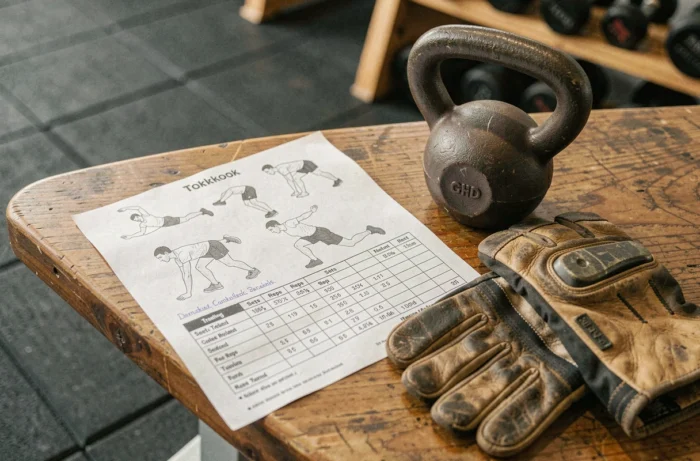
This division into four blocks can easily be printed in table form. Plan one column for each parameter: exercise, sets, repetitions, rest.
Rest times and paper format: the details that change the session
On a screen, an app manages the timer for you. On paper, you need to anticipate. Note the rest times directly on the sheet, next to each exercise.
Ballistic movements require short rest, between thirty and sixty seconds. Heavy grinds require more recovery to maintain technical quality. If you perform kettlebell presses with only thirty seconds of rest, the last set will be rushed.
Adapting the format to the training location
A standard A4 sheet works in a garage or living room. For outdoor training, laminate the sheet or slip it into a transparent pocket. Sweat and wet grass can destroy paper in just a few sessions.
Also consider readability. A font that is too small forces you to lean in between sets. Use a text size large enough to read from two meters away.
Adapting the session to a single kettlebell
Many home practitioners only have one kettlebell. The printed sheet should then include unilateral exercises (one-arm press, one-arm row, weighted lunge on one side) to compensate for the lack of variable load. Work each side separately and always start with the weaker side to balance muscle imbalances.
If the single load becomes too light for the legs but remains heavy for the shoulders, adjust the number of repetitions per block rather than seeking an intermediate weight. The legs will do more repetitions, while the shoulders will do fewer.
A printed sheet doesn’t need to be sophisticated to be effective. Four clear blocks, visible rest times, a space to note results: that’s the minimum that transforms a list of exercises into a real training program.