
A load-bearing wall discovered to be cracked after the quotes have been signed, a ventilation system installed too late, causing condensation on new insulation: most renovation failures stem from poor planning rather than a lack of budget. Successful renovation work depends on precise sequencing, with each task setting the stage for the next.
Assessing the building before renovation: what can change the rest of the project
Before pricing anything, inspect the structure. A sagging floor, a roof frame damaged by wood-boring insects, or rising damp in the foundation walls can radically change the nature of the project. Skip this step, and you risk installing high-performance insulation on a surface that is already deteriorating.
In older buildings, how the building responds to moisture guides the choice of insulation. For example, Qualitel notes that hemp wool may be suitable for some older buildings because it is permeable to water vapour, while also pointing out that there is still limited long-term data on its lifespan. Check the product’s technical specifications and installation requirements before approving a quote.
A thermal assessment complements the visual inspection. It identifies the main sources of heat loss (roof, windows and doors, walls) and helps prioritise the work. Without this assessment, you are renovating blind, making budget decisions based on gut feeling rather than data. To explore Renov Motiv’s services and compare the available options, this preliminary assessment remains the most reliable starting point.

Insulation and ventilation: two areas to address together
Attics are often insulated first because they are where heat loss is greatest. Wall insulation comes next, followed by replacing windows and doors. This order is widely accepted, but it can conceal a common pitfall.
Insulating without upgrading ventilation causes condensation and mould. Older homes “breathe” through gaps in their airtightness. Once high-performance insulation seals those gaps, humid indoor air has nowhere to escape. Mechanical ventilation (VMC) must be properly sized and installed at the same time as the insulation, not afterwards.
Summer comfort: a criterion that’s often overlooked
Energy performance is not measured in winter alone. Qualitel points out that some insulation solutions can improve summer comfort, but their performance depends on their properties and how they are installed. Insulation with high thermal mass (wood fibre, for example) slows the penetration of summer heat, whereas lightweight insulation allows indoor temperatures to rise as soon as the first hot days arrive.
When renovating a home beneath the roof, the choice of insulation affects comfort in July just as much as in January. Considering summer comfort from the outset can help you avoid having to install air conditioning a few months after the work is complete.
Renovation budget and grants: plan for changes
A renovation budget has three components: materials, labour, and additional costs that are easy to underestimate (skip hire, temporary accommodation if the home is uninhabitable, mandatory assessments). Set aside a contingency fund, because renovation projects almost always uncover unexpected issues.
Renovation grants can change between the application process and the start of the work. Before signing the quotes, check the eligibility criteria and application requirements again using official sources. A France Rénov’ adviser can confirm which schemes apply to your home.
Here are a few things to check before approving the financing:
- Does the contractor hold the RGE (Recognized Environmental Guarantor) certification required by most public grants?
- Has the grant application been submitted before work actually begins, as is generally required by current schemes?
- Do the quotes list materials and installation separately, making it easier to process the application and compare contractors?
Coordinating contractors and scheduling the work
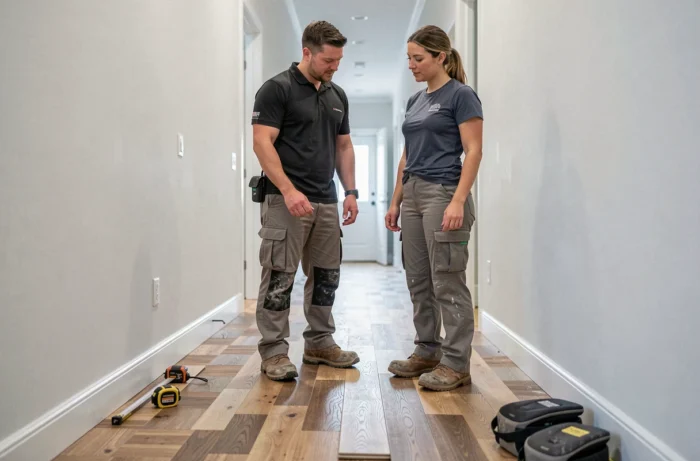
On a renovation project, the order in which tradespeople work is not interchangeable. Structural work (structural repairs, masonry) comes first. Next are insulation and ventilation, followed by utilities (electrical, plumbing, heating), and finally the finishing work (plastering, painting, flooring).
The most costly scheduling mistakes
Installing flooring before the plumber has finished running the pipes means taking it all up again. Painting before the electrical connections are complete leaves visible touch-up marks. Each trade depends on the one before it, and a delay in one area pushes back the entire schedule.
To avoid scheduling conflicts, draw up a shared timeline with the contractors as soon as work begins. A simple table is enough:
| Phase | Trade | Prerequisites |
|---|---|---|
| Structural work | Mason, carpenter | Building permit or prior declaration obtained |
| Insulation and ventilation | Drywall installer, VMC installer | Structural work complete, roof watertight |
| Utilities | Electrician, plumber, heating engineer | Partitions installed, service ducts accessible |
| Finishing work | Painter, tiler, joiner | Utilities tested and approved |
Project handover
Once the work is complete, carry out the handover in the presence of each contractor involved. Record any outstanding issues in writing (poor finish, equipment that does not match the quote). This handover report triggers the statutory warranties, including the ten-year structural warranty. Without a signed document, asserting your rights if defects arise becomes much more difficult.
Renovating a home is not simply a matter of ticking off a list of steps in order. It is a technical process in which the initial assessment, the combination of insulation and ventilation, and contractor coordination have a far greater impact on the final result than the amount spent.