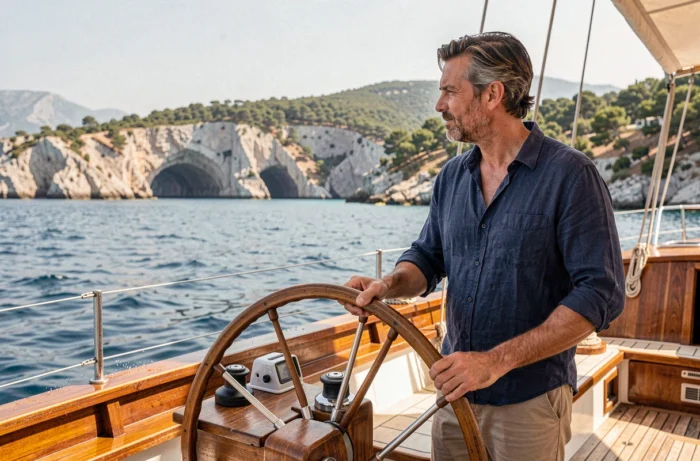
Navigating along a coastline is about more than choosing a destination on a map. The journey itself, anchoring restrictions, the presence of marine protected areas and practical access to shore all shape the experience just as much as the scenery. Before dreaming of turquoise coves, it’s worth understanding what sets a successful coastal getaway apart from a route full of unwelcome regulatory surprises.
Anchoring zones and coastal regulations: what can change your route
The freedom to drop anchor wherever you please no longer exists along most French and Mediterranean coastlines. In the Calanques, for example, anchoring is subject to specific rules designed to protect Posidonia seagrass beds. Some areas prohibit anchoring altogether, while eco-mooring buoys allow boats to tie up without damaging the seabed.
These restrictions vary depending on the location, type of boat and time of year, and may change from one season to the next. Checking local regulations and protected-area maps before setting off is an essential part of planning, not just an administrative detail.
Marine protected areas do not automatically prohibit recreational boating. The distinction is important: it is often still possible to pass through a protected area, but anchoring or going ashore may be restricted or prohibited. For anyone hoping to explore the coast by boat without having to improvise when faced with a prohibition sign, planning the route in advance makes all the difference.
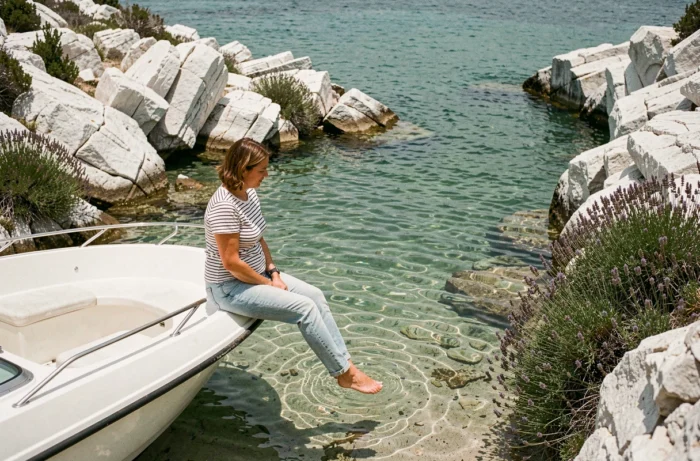
Electric boats on coastal getaways: real-world range and charging constraints
Electric boats appeal for their quiet operation and lack of local emissions. On paper, they’re the ideal choice for environmentally conscious coastal cruising. In practice, a shore power outlet is not the same as a fast charger. Power availability at marinas is often limited, and dedicated boat-charging stations are rare outside a handful of equipped ports.
This reality has a direct impact on your choice of stops. A route designed for a conventional motorboat, with short hops between secluded coves, may be impractical in an electric boat if there’s no charging point within a reasonable distance.
Plan around available power
The most reliable approach is to build your route around ports with verified charging facilities, then explore from these fixed points. This style of boating calls for a different, slower pace, with longer stops. It also encourages you to explore areas close to your home port rather than stringing together a series of crossings.
- Identify ports with charging stations suited to your boat’s battery capacity, and contact the harbormaster before departure
- Allow a range buffer for the return trip, as sea conditions (wind and currents) can increase energy consumption
- Choose short loops that return to a charging port rather than one-way trips between distant stops
A realistic route is more important than a spectacular one. An accessible, permitted anchorage near an equipped port will offer a better experience than a distant cove reached with the battery running low.
France’s coastline under sail: three stretches that reward a slower pace
Adding more stops can create the illusion of making the most of a trip. Spending longer on a shorter stretch lets you watch the light change, wait for a favorable weather window to anchor outside a marina, and discover ways to get ashore that you’d miss when passing through quickly.
Southern Brittany between La Trinité-sur-Mer and Belle-Île
This stretch offers a variety of anchorages over a short distance. Tidal conditions set a natural pace: you can’t sail whenever you like, and that constraint encourages you to stop, explore on foot and take in your surroundings. Tidal currents shape the route just as much as the skipper’s preferences.
Provençal coast between Cassis and La Ciotat
The proximity of the Calanques offers spectacular rocky scenery, but anchoring regulations are strict. Eco-mooring buoys, when available, should be booked early in the season. Outside the summer months, visitor numbers fall and there are more options for permitted anchoring.
Western Corsica between Ajaccio and Scandola
The Scandola Nature Reserve prohibits anchoring and restricts motorized boating in certain areas. Sailing near Scandola requires knowing the exact boundaries of the protected area. Updated nautical charts and information from the harbormasters in Ajaccio or Galeria are the only reliable sources.
Coastal pressures and responsible boating
Coastal areas face pressures that go beyond recreational boating. Erosion, coastal development and summer overcrowding damage these environments far more than the impact of recreational boats alone. Even so, boating adds to the cumulative pressure when it concentrates on the same spots at the same times.
Boating outside peak periods, choosing lesser-known but permitted anchorages, and respecting marine seagrass protection zones are practical steps that can reduce the impact of a getaway.
- Check Natura 2000 maps and local anchoring regulations before each stop
- Use eco-mooring buoys instead of anchoring whenever they are available
- Avoid discharging waste or wastewater in coastal areas, even when local regulations do not explicitly prohibit it
- Plan your trip for June or September to reduce pressure on the busiest sites
The best coastal getaway isn’t the one that ticks off the most destinations. It’s the one whose route takes account of local conditions, energy constraints and the limits of what the coastline can absorb. A well-chosen anchorage in a protected, permitted cove leaves a more lasting impression than a string of postcard views glimpsed from the cockpit.