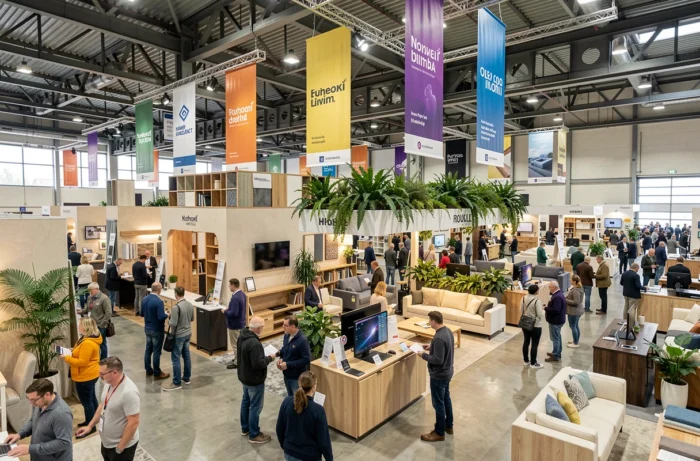
Every year, habitat fairs in France serve as a barometer for renovation, construction, and development projects. In 2026, the regional editions of Habitat Expo and partner fairs reveal a clear shift: summer comfort, climate adaptation, and the reuse of materials are taking as much space as traditional winter insulation.
Summer Comfort and Thermal Lag: The New Common Thread of Habitat Fairs
Have you noticed that conversations about habitat almost exclusively revolved around heating and insulation against the cold? This paradigm has shifted. Habitat fairs now dedicate an increasing portion of their programming to summer comfort.
In Toulouse, at the fair at MEETT, exhibitors showcased solar protections, air conditioning without outdoor units, and photovoltaic panels. A life-size model allowed visitors to concretely understand the thermal lag of insulating materials. This concept refers to the time it takes for outside heat to penetrate a wall: the longer this time, the cooler the house remains without air conditioning.
Professionals following the news on Habitat Expo find this same focus in several cities. In Angers, the pathways dedicated to climate adaptation and bio-based materials attracted over 16,300 visitors for more than 300 exhibitors. The fair no longer just showcases products: it explains why wood fiber insulation protects better against heat waves than traditional polystyrene.
Reuse and Bio-Based Materials in Habitat Fairs
The other structuring trend concerns reuse and materials of biological origin. Organizers are integrating these topics directly into the programming, not just in commercial stands.
Why this choice? Because the cost of new materials remains high and regulations are pushing towards low-carbon solutions. Visitors are looking for concrete answers.
- Bio-based materials: hemp wool, cellulose wadding, wood fiber panels. These insulators offer good thermal lag and a reduced carbon footprint compared to traditional mineral wools.
- Reuse sectors: some fairs offer spaces where professionals resell joinery, sanitary ware, or structural elements from deconstructions. Visitors can find pieces at reduced prices.
- Responsible design: decorators and interior architects present layouts that combine aesthetics and recycled materials, far from the cliché of “DIY recovery.”
Housing Adaptation for Aging: A Topic Coming Out of the Niche
General habitat fairs are no longer just aimed at young buyers or energy renovators. Home autonomy and adaptation for aging are gaining visibility.
In Angers, dedicated stands offered solutions to adapt a home to its occupants in the long term: walk-in showers, ramps, simplified home automation, automatic lighting. Adapting your home before you need it is cheaper than in an emergency.
This topic also interests renovation professionals. Integrating these adaptations right from an energy renovation project allows for cost-sharing: a craftsman who is renovating a bathroom for insulation can simultaneously install an accessible shower.

Support and Renovation Aid at the Fairs
Visitors are no longer just coming to see products. They are looking for support on public aid schemes. Several regional fairs, like the one in Angers, have integrated advisory spaces where organizations explain the available aids for energy renovation and housing adaptation.
This educational dimension changes the fair experience. Visitors leave with a rough financing plan, not just a product catalog. The fair becomes a temporary one-stop shop for habitat projects.
Decor Trends and Garden Layout: What Attracts Visitors in 2026
Beyond technical renovation, habitat fairs remain a meeting point for interior decoration and outdoor layout. The trends observed this year revolve around a few clear axes.
Indoors, visitors are looking for modular layout solutions. Small spaces require multifunctional furniture, built-in storage, and removable partitions. Exhibitors are responding to this demand with compact ranges that do not sacrifice design.
On the garden and outdoor spaces side, water-efficient layouts dominate the stands. Mulches, Mediterranean plants, rainwater harvesting systems: landscaping professionals are adapting their offerings to increasingly dry summers.
- Composite wood or recycled material terraces, which require little maintenance.
- Bioclimatic pergolas with adjustable slats, which regulate heat without consuming energy.
- Solar lighting integrated into pathways and garden borders.
These solutions are appealing because they combine aesthetics, durability, and control over maintenance costs. The fairs allow for direct comparison of finishes and materials, something an online catalog cannot replace.
Why Regional Fairs Remain Relevant
Despite the proliferation of online platforms, physical fairs retain an advantage: direct contact with local professionals. A craftsman present at a regional fair operates within a limited radius. Visitors can verify their references, see their work, and negotiate a quote on-site.
The 2026 editions, from Toulouse to Angers, confirm that the habitat fair remains an event rooted in the habits of French households. The format is evolving, the themes are expanding to include climate and aging, but the function remains the same: to connect a concrete project with the right stakeholders.