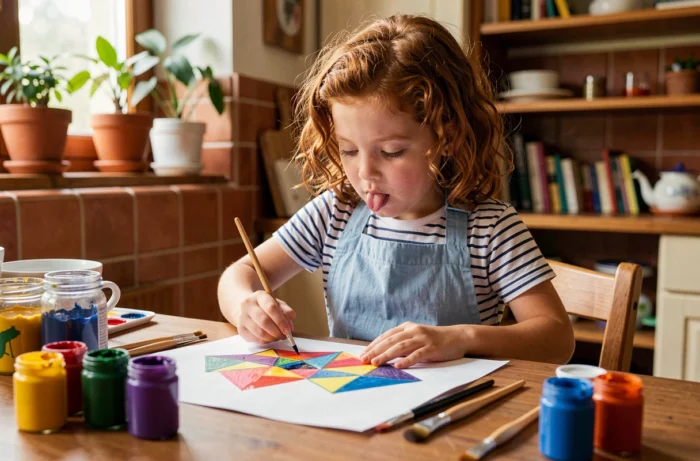
A four-year-old child flipping cushions to build a tunnel in the living room is not wasting time. They are testing supports, anticipating a collapse, negotiating space with their body. This type of situation, seemingly mundane, engages motor and cognitive skills that highly structured activities do not always tap into. We can structure daily life around playful and educational activities without turning every moment into a formal workshop.
Free play at home: why unstructured play develops better than we think
A report published in 2024 warns of the emergence of a “generation of indoor children,” marked by a decrease in free play and time spent outside without adults. We tend to fill days with scheduled activities, but free play remains an underutilized lever for emotional development.
In practical terms, we can start by setting aside a daily time slot where the child chooses what to do on their own. No instructions, no imposed materials. A cardboard box, some clothespins, and a few kitchen containers are enough. The goal is not to produce something but to let the child organize their own scenario.
The catalogs of educational games and developmental materials found on le-petit-castor.fr can complement these free moments with resources suitable for each age group, without replacing spontaneous exploration.
For the youngest, an improvised motor course in the living room (stacked cushions, overturned chairs, a blanket stretched between two pieces of furniture) works on balance and coordination. For children aged five and up, offering a bin of small objects to sort by color, size, or texture adds a logical dimension without formality.
Sensorial activities with everyday materials
You don’t need to buy specialized modeling clay to work on fine motor skills. A mixture of flour, salt, and water creates a homemade modeling dough that engages the same kneading and shaping actions. The child measures, mixes, and observes the transformation of the texture. It is an activity for understanding materials as much as a manual exercise.
Another concrete situation: cooking. Peeling a tangerine, mashing a banana with a fork, pouring water from a pitcher into a glass. These everyday actions strengthen hand-eye coordination and concentration on a short task.
Three easy-to-prepare sensory activities
- A sensory bin filled with rice, lentils, or sand, in which small objects are hidden to be found by touch, with eyes closed. The child refines their tactile perception and learns to name what they feel.
- Plastic bottles filled with colored water using food coloring, which the child shakes, mixes, or lines up by shade. Learning colors comes through direct manipulation.
- A transfer tray with spoons, tongs, and funnels to move seeds from one container to another. This exercise, inspired by Montessori pedagogy, develops patience and precision.
Screens and young children: the regulatory framework to know
Since a ministerial decree on July 2, 2025, the use of screens is prohibited for children under three years old in childcare settings such as nurseries and micro-nurseries. This measure reflects a clear stance from French health authorities on early exposure.
At home, the High Council for Public Health recommends avoiding screens before three years old when they are not accompanied by parental interaction. Beyond this age, it does not set a universal time limit but encourages consideration of content, sleep, and the presence of an adult.
In practice, we replace screen time with an activity at home that engages hands and attention. It is not a matter of parental morality; it is a concrete trade-off in the day. Feedback on this point varies among families and the rhythms of each child, but the principle remains simple: every slot of screen time removed frees up time for a sensory or motor activity.
Outdoor outings and autonomous exploration for children
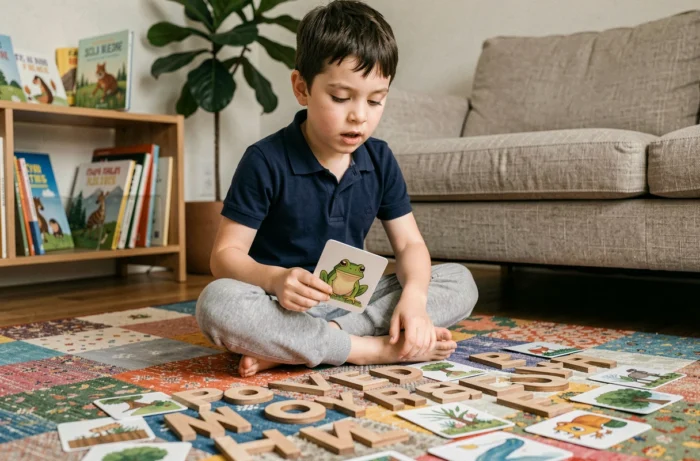
A garden, a park, a stretch of sidewalk with puddles after rain. The outdoor environment offers stimuli that the indoors cannot replicate: variations in terrain, sounds, smells, changing weather. For a child, walking on uneven ground engages more stabilizing muscles than a flat living room floor.
We can structure an outing without fully directing it. Giving a simple objective is enough: collect five different leaves, find three distinct-sized stones, observe an insect for two minutes. Unstructured outdoor exploration fosters autonomy and decision-making.
Seasonally adapted outdoor activity ideas
- In spring: plant seeds in a pot and follow their growth day by day. The child learns patience and vocabulary related to nature (stem, root, bud).
- In summer: water games with basins, cups, and colanders. Transferring liquid between containers works on motor skills and understanding of volumes.
- In autumn: collecting leaves, acorns, and chestnuts for sorting by shape or color, then gluing them onto a piece of cardboard.
- In winter: observing animal or bird tracks in mud or snow, with a notebook to draw what they see.
Outdoor activity does not need to be long. About twenty minutes of free play outside, even in a small space, provides a sensory break in the day that later enhances concentration for quieter activities at home. A child’s daily life becomes richer when alternating active outdoor breaks with indoor manipulation times, without trying to fill every minute with an educational program.