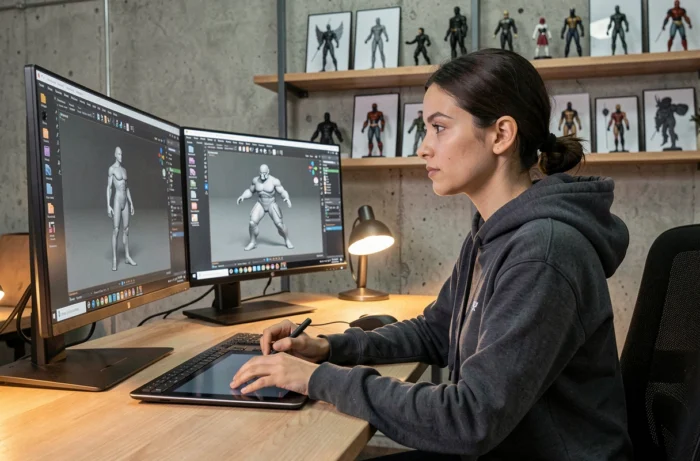
The 3D animation market is undergoing a phase of reorganization. Global jobs in the VFX and animation sectors are experiencing slight year-on-year growth, with particularly marked growth in certain technical specialties.
At the same time, French animation production is facing a contraction: the Audiens Datalab reports a decrease of about 5% in workforce in the first half of 2026, and the CNC reports a drop in orders for animated films and series of about 10% in 2025. Understanding where promising careers lie requires examining which positions are hiring, in what contexts, and under what geographical conditions.
Growing and Declining Positions in 3D Animation
Not all jobs in 3D animation follow the same trajectory. A global atlas of VFX and animation published in September 2026 distinguishes the specialties that are growing from those that are stagnating.
| Specialty | Employment Trend | Main Context |
|---|---|---|
| 3D Environments / Matte Painting | Marked Growth | Films, series, virtual production |
| FX / Simulation | Marked Growth | VFX, AAA video games |
| Character FX | Marked Growth | VFX, animated cinema |
| Technical Supervision / Pipeline | Sustained Demand | Studios of all sizes |
| Character Animation (Generalist Positions) | Stable to Declining Depending on Markets | Traditional animation studios |
The most technical specialties are driving the market. Positions for FX artists, TDs (technical directors), and 3D environment specialists respond to a demand linked to heavy visual effects productions and real-time engines like Unreal Engine.
In contrast, generalist 3D animator profiles are more pressured by budget cuts, particularly in France where orders for animated series have significantly declined. A comprehensive overview of career opportunities on Emploi Parlons Net details the pathways accessible after training in animation.
Geography of 3D Careers: Concentration in Île-de-France and International Attractiveness
The location of a 3D animation professional weighs as much as their specialty in their job prospects. A CNC study published in 2026 confirms that more than 70% of VFX and digital animation establishments are located in Île-de-France. This concentration creates a dense market for studio positions, but also strong competition for salaries and contracts.
Outside of Paris, a few regional hubs exist (Angoulême, Lyon, Montpellier), but they do not reach the critical mass of Île-de-France. For professionals willing to relocate, some European and North American countries offer tax incentives that attract productions and, consequently, hiring.
Freelance and Remote Work in 3D Animation
Remote work has changed the game for certain pipeline jobs. Positions in modeling, texturing, or compositing lend themselves to freelancing, as deliverables are clearly defined and transferable. Roles requiring close real-time coordination (supervision, layout, art direction) remain more tied to studio presence.
Freelancing opens access to international studios without relocating, provided one masters remote collaboration tools and standardized pipelines. Specialized recruitment platforms list offers for junior 3D artists working remotely, including from France or Switzerland.
Impact of Artificial Intelligence on 3D Animation Jobs
Generative AI is redefining certain links in the 3D production chain. Tools for assisting with texturing, generating environments, or automated motion capture accelerate tasks that were previously manual. This does not eliminate positions, but shifts the value towards supervision, quality control, and art direction.
Profiles that combine technical animation skills with the ability to manage AI tools are positioning themselves in a growing niche. Studios are gradually integrating these technologies into their pipelines, creating a demand for TDs capable of developing and maintaining these hybrid workflows.
Technical Skills That Make a Difference
- Mastery of a real-time engine (Unreal Engine, Unity) in addition to classic software like Maya or Houdini
- Knowledge of virtual production pipelines, where on-set shooting relies on 3D environments projected in real-time
- Ability to script (Python, MEL) to automate repetitive tasks and adapt studio tools
- Understanding of physical simulation principles (fluids, fabrics, destruction) for FX positions
These cross-disciplinary skills allow transitions from one sector to another: a FX artist trained in Houdini can work on both an animated feature film and a video game cinematic or an immersive virtual reality experience.
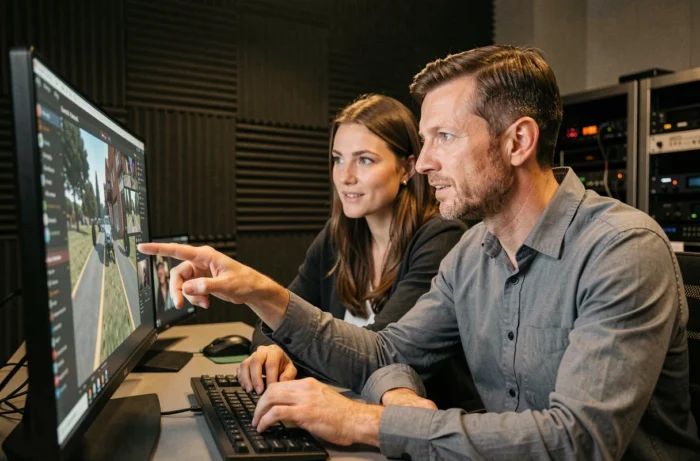
Sectors Hiring 3D Animation Profiles Beyond Cinema
Competing articles focus on cinema and video games. However, several other sectors are absorbing a growing share of 3D skills.
- Virtual production for advertising and events employs 3D environmental artists and lighting artists trained in real-time engines
- Architecture and industrial design use 3D visualization for development projects, with tools shared with animation
- The medical and pharmaceutical sector invests in 3D modeling for surgical simulation and training
- Theme parks, including Disneyland Paris and other sites in Europe, hire animation and design profiles for their immersive experiences
This sector diversification offers a form of resilience. When orders for animated series decline, 3D skills find opportunities in non-audiovisual sectors. Technical versatility remains the best lever for professional mobility.
The 3D animation market is no longer limited to a list of classic jobs in a linear pipeline. The structuring data is the gap between the contraction of French animation production and the growth of technical niches on a global scale. Professionals who target growing specialties, accept geographical mobility or international freelancing, and integrate emerging tools into their practice position themselves on the favorable side of this gap.